Refer a friend to Duo Dental Clinic and receive a gift card as our thank you!
May 18, 2026
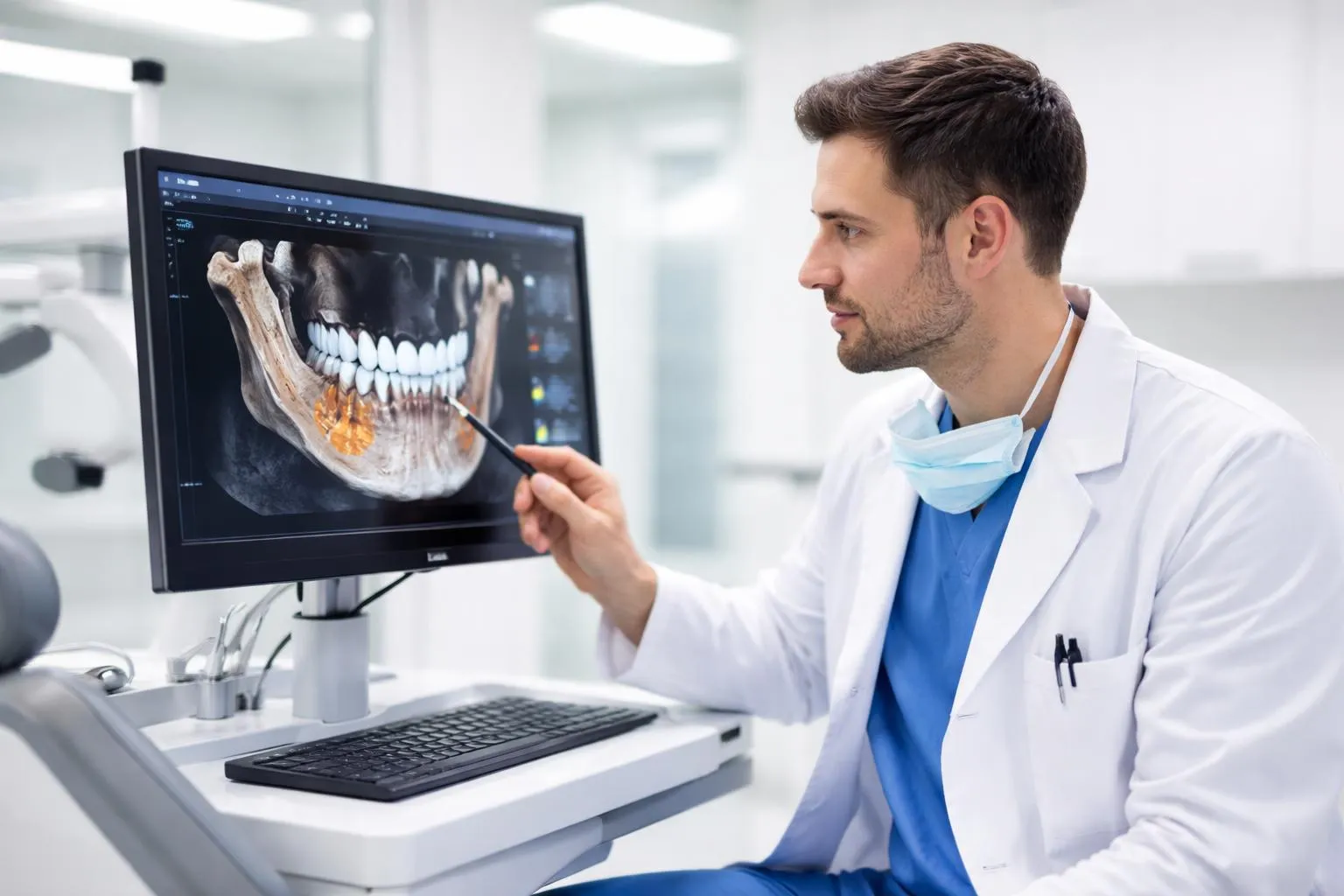
If you need oral surgery, you probably care about one thing more than anything else: you want it done safely.
That sounds obvious, but it matters because oral surgery is planned around structures you cannot see by looking in the mirror. Teeth can sit close to nerves. Roots can curve in odd directions. Bone may be thinner than expected. A sinus might be lower than it looked on a standard X-ray. These details change the plan, and sometimes they change it a lot.
This is where advanced imaging, especially 3D imaging like cone-beam computed tomography, or CBCT, earns its place. It gives oral surgeons a more complete view before treatment begins. That means fewer guesses, fewer surprises, and a better chance of a smooth procedure.
Traditional dental X-rays still have value. They are quick, familiar, and useful for many routine cases. But when surgery gets more complex, a flat image can only tell part of the story. A 3D scan adds depth, and in oral surgery, depth is often the difference between a straightforward case and a risky one.
A regular dental X-ray turns a three-dimensional area into a two-dimensional picture. Sometimes that is enough. Sometimes it really is not.
Think about an impacted wisdom tooth. On a standard X-ray, it may look close to the nerve in the lower jaw. But “close” is not a precise measurement. Is the tooth sitting beside the nerve, above it, or wrapped around it? That distinction matters. A lot.
The same goes for dental implants. A 2D image may suggest there is enough bone, but it cannot always show the full width, angle, or shape of the site. If the implant is placed without a clear picture of nearby nerves or the sinus cavity, the margin for error gets smaller.
3D imaging helps because it shows the actual spatial relationship between structures. That sounds technical, but the idea is simple: your surgeon can see where things really are, not just how they overlap on a flat film.
CBCT scans create detailed images of the teeth, jawbone, roots, nerves, and nearby anatomy. That extra detail helps in several ways.
First, it can reveal anatomy that is hard to judge on 2D X-rays. Curved roots, extra root canals, hidden bone defects, and impacted teeth often become much easier to evaluate in three dimensions.
Second, it helps identify pathology more accurately. Cysts, lesions, or areas of bone loss may look vague on a traditional image. A 3D scan can help define their size, position, and relationship to surrounding tissue. That matters when deciding whether something needs monitoring, biopsy, removal, or referral.
Third, it shows anatomic variation, and people vary more than most patients realize. Nerves do not always follow the same textbook path. Sinuses are not all shaped the same way. Bone density is not uniform from one person to the next. Good surgical planning respects that reality.
I think this is one of the quiet strengths of advanced imaging. It does not just help with dramatic cases. It helps with the normal messiness of real human anatomy.
No scan can remove all risk from surgery. Any honest provider should say that plainly. But better information usually leads to better decisions, and better decisions tend to reduce avoidable complications.
When an oral surgeon can map out the exact position of a nerve before surgery, the chance of injuring that nerve may drop. When the sinus floor is clearly visible before an implant, the risk of sinus perforation may be lower. When bone defects are identified early, the surgeon can prepare for grafting instead of discovering the issue midway through the procedure.
This is one reason advanced imaging often makes procedures feel calmer, both for the surgeon and the patient. It is easier to move carefully when the roadmap is clear.
That does not mean every case needs a 3D scan. It means the right imaging should match the procedure. For a simple issue, a standard X-ray may be enough. For implants, impacted teeth, grafting, or complex extractions, 3D imaging often gives useful information that can shape a safer plan.
Dental implants are a good example because they depend on precision. An implant has to go into the right spot, at the right angle, and into bone that can support it over time.
That sounds straightforward until you remember what surrounds the implant site. In the upper jaw, there may be limited bone under the sinus. In the lower jaw, the inferior alveolar nerve may sit close to where the implant needs to go. Bone width can also be misleading if you are only looking at a flat image.
A 3D scan helps the surgeon measure bone volume more accurately and choose the implant size and position with more confidence. It can also show whether a patient may need bone grafting before implant placement, rather than discovering that problem late in the process.
For patients, this matters because long-term implant success starts long before the implant is actually placed. Good planning is part of the treatment, not just a preliminary step.
Wisdom teeth do not always follow simple rules. Some grow in sideways. Some remain trapped under the gums. Some sit close to the jaw nerve. Some have roots that make extraction trickier than they first appear.
With 3D imaging, the surgeon can evaluate the tooth from multiple angles and decide on the safest approach. Will the tooth need to be sectioned? Is the nerve at real risk? Is the crown pushing against the second molar? Is there an unexpected cyst or bone issue nearby?
These questions are not academic. They affect how the extraction is performed and what recovery may look like. Patients often assume a tooth removal is just a matter of pulling hard enough. Oral surgeons know better. The planning stage often determines how controlled the procedure feels.
Bone grafting is another area where imaging matters. If a patient has lost bone because of missing teeth, gum disease, trauma, or infection, the surgeon needs a clear picture of what remains.
A 3D scan can help assess the shape and quality of the available bone and show whether grafting is needed before implants or other reconstructive work. It can also help estimate how much grafting may be required and where the most predictable support can be created.
This is useful for setting expectations. Patients deserve to know whether treatment will be simple or more involved. A scan cannot answer every question, but it can turn a vague estimate into a grounded conversation.
This part gets overlooked, but I think it matters more than clinics sometimes admit. Many people are not scared of dentistry itself. They are scared of the unknown.
A 3D scan makes explanations easier. When patients can actually see the impacted tooth pressing against another tooth, or the limited bone under the sinus, the treatment plan starts to make sense. The risks feel more concrete. The recommendation feels less arbitrary.
That can make informed consent more meaningful. Instead of nodding along to unfamiliar terms, patients can ask better questions and understand the logic behind the plan.
Trust grows faster when people can see what the clinician sees.
Often, yes, though “faster” is not really the point. Safer and more predictable matters more. Still, those things often lead to efficiency.
When a surgeon has already studied the anatomy in detail, there is less need for improvisation in the chair. The team can prepare properly. The approach can be chosen in advance. Potential obstacles are less likely to appear out of nowhere.
That may shorten procedure time. It may also make recovery a bit easier if the surgery is more controlled and less traumatic. Every case is different, but good planning usually pays off.
If you are preparing for oral surgery, a few simple questions can tell you a lot about the planning process:
Will my procedure be planned with 3D imaging?
If not, what makes a standard X-ray enough for my case?
Are there nerves, sinuses, or other structures close to the treatment area?
Will the scan affect the treatment plan or timeline?
Can you show me what you see on the scan?
These are reasonable questions. You are not being difficult. You are asking how your care is being planned.
A good surgical experience is not only about what happens during the procedure. It starts earlier, with diagnosis, imaging, case review, and a clear explanation of the options.
That is one reason many patients look for a clinic that uses advanced imaging for implant planning, difficult extractions, and other surgical cases. The technology matters, but so does how it is used. A scan is only useful if the surgeon takes the time to interpret it carefully and build the treatment around what it shows.
When a practice combines detailed imaging with thoughtful surgical planning, patients often feel the difference. Conversations are clearer. Risks are discussed honestly. The plan feels tailored instead of generic.
And honestly, that is what most people want. Not flashy technology for its own sake. Just fewer surprises, more clarity, and a safer path through treatment.
Oral surgery works best when the surgeon knows exactly what they are walking into. Advanced imaging, especially 3D CBCT scans, helps make that possible.
It can reveal anatomy that standard X-rays miss, guide safer implant placement, improve planning for impacted teeth and grafting, and help patients understand their treatment with less confusion. In many cases, it also reduces the uncertainty that makes surgery feel intimidating in the first place.
If you have been told you need implants, a surgical extraction, or another complex oral procedure, it is worth asking how the case will be planned. A clearer picture before surgery can lead to a better experience during it.
Get Started Today
Your oral health matters. Whether you’re visiting for preventive care or urgent treatment, our experienced and caring team is here to help.
.svg)